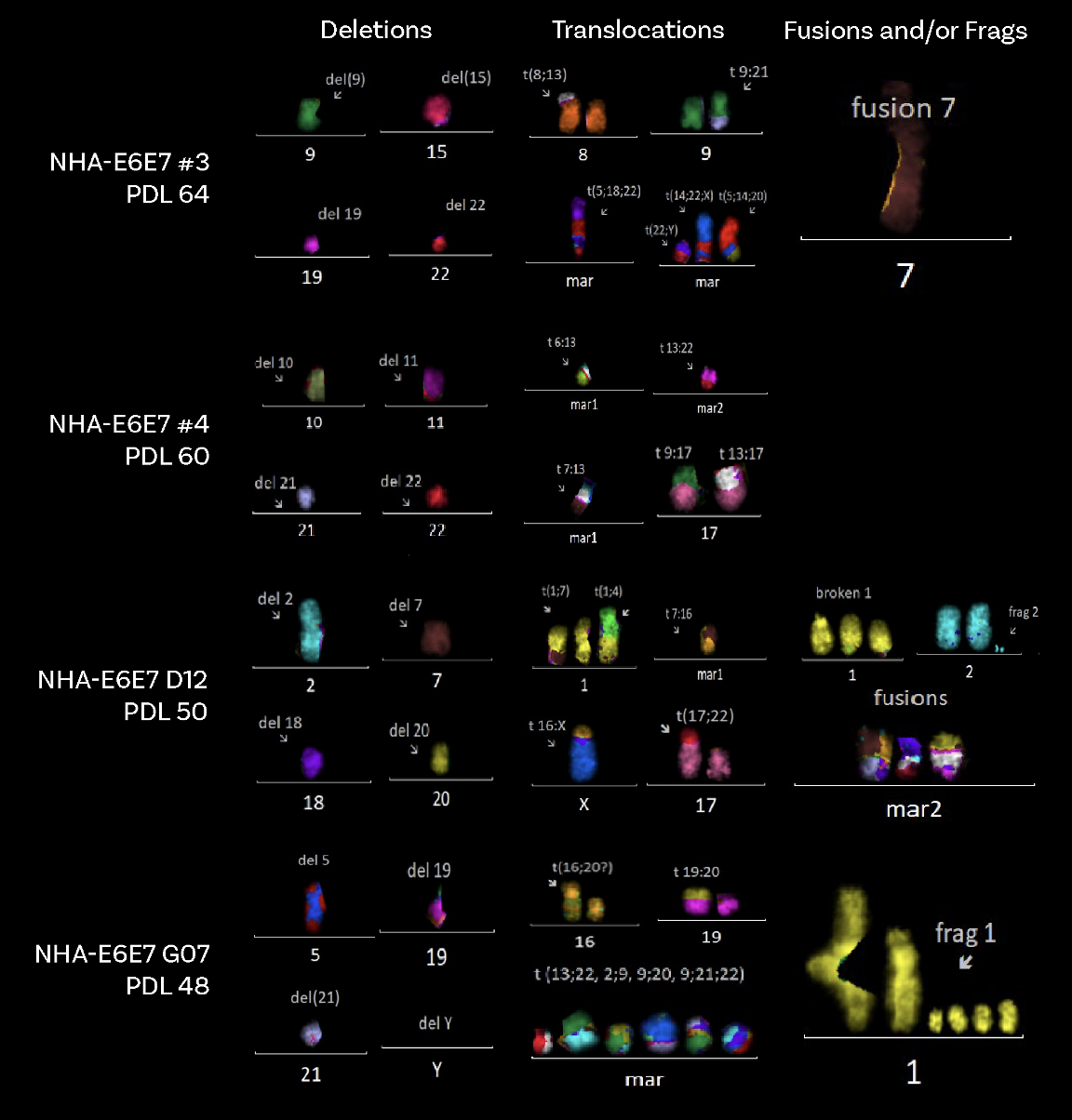
Loss of p53 and Rb enables continued cell division despite progressive telomere erosion, ultimately triggering telomere crisis. While recent work has clarified mechanisms of chromatin bridge resolution, the longitudinal dynamics of structural damage through crisis remain incompletely understood. We transduced normal human astrocyte (NHA) cells with HPV18 E6/E7 and tracked them across extended population doublings. NHA E6/E7 cells showed progressive telomere shortening, anaphase bridges, and a growth plateau consistent with crisis. Multicolor FISH revealed subclonal chromosomal abnormalities largely invisible to short-read sequencing, with acrocentric chromosomes disproportionately affected: chromosome 13 was abnormal in over 92% of metaphases, and chromosomes 21 and 22 were similarly enriched. Translocations involving chromosome 13 were transient, replaced at later passages, while numerical aberrations persisted. Immunofluorescence revealed compact spherical nucleoli replaced by dispersed necklace-like structures, indicating a large-scale reorganization of nucleolar structure in response to telomere dysfunction. To determine whether these changes reflected altered chromosomal organization in the nucleus, we performed Hi-C and deployed KaryoScope, our alignment-free k-mer-based approach that recovers trans-chromosomal signal from repetitive acrocentric short arms. Inter-chromosomal contacts among nucleolar organizing region-bearing acrocentric chromosomes were markedly and persistently depleted in E6/E7 cells. Together, cytogenetic, imaging, and chromatin-contact data identify the nucleolus as a structural nexus linking telomere dysfunction to large-scale genomic rearrangement.
Telomere Dysfunction in Human Astrocytes Drives Acrocentric Chromosome Instability and Nucleolar Reorganization
Ogechukwu Mbegbu, Yi-An Chen, Yue Hao, Noelle Fukushima, T. Rhyker Ranallo-Benavidez, Ava Bryan, Szehoi Chan, Nikki Messick, Maria Kyriakidou, Tianpeng Zhang, Pippa F Cosper, Floris P Barthel†
2026.
bioRxiv. 2026