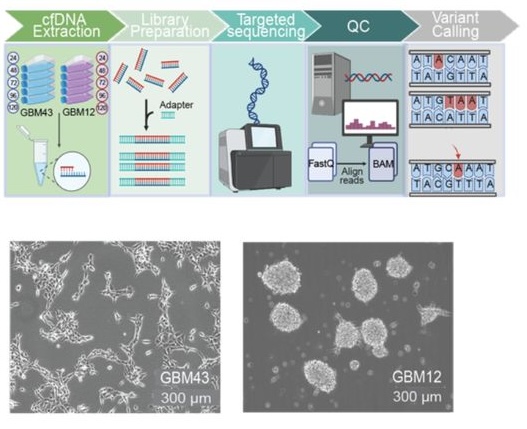
Glioblastoma (GBM) is a highly aggressive brain tumor with limited options for longitudinal monitoring. We evaluated the potential of cell-free DNA (cfDNA) as a real-time biomarker of tumor burden under tightly controlled conditions. We measured the cfDNA release dynamics, fragmentation sizes, and variant allele frequencies (VAF) in patient-derived GBM cell cultures. Time series of cfDNA were collected and analyzed in treatment-naive monocultures, during temozolomide (TMZ) treatment, and in co-culture with normal human astrocyte (NHA) cells. Longitudinal collection of media from individual cultures demonstrated that cfDNA yield increased, indicating the ability to use cfDNA to track tumor burden over time. Using a co-culture system, we deconvoluted cfDNA admixtures by analyzing yield, fragment size patterns, and cell line-specific variants. The exclusive detection of NHA- and GBM-specific mutations confirmed the distinct contributions of each cell type. Finally, TMZ treatment of GBM cells prompted an increase in cfDNA yield and VAF, suggesting that the effects of therapy could be measured using cfDNA. These findings support cfDNA as a non-invasive biomarker for real-time monitoring of GBM progression and treatment response, with clinical potential as a liquid biopsy tool in glioblastoma management.
KEY POINTS
- cfDNA yield and variant allele frequencies (VAFs) correlate with GBM tumor burden.
- cfDNA properties can be used to differentiate between cell types in a mixed population.
- TMZ treatment increases cfDNA yield and VAFs, reflecting treatment response.