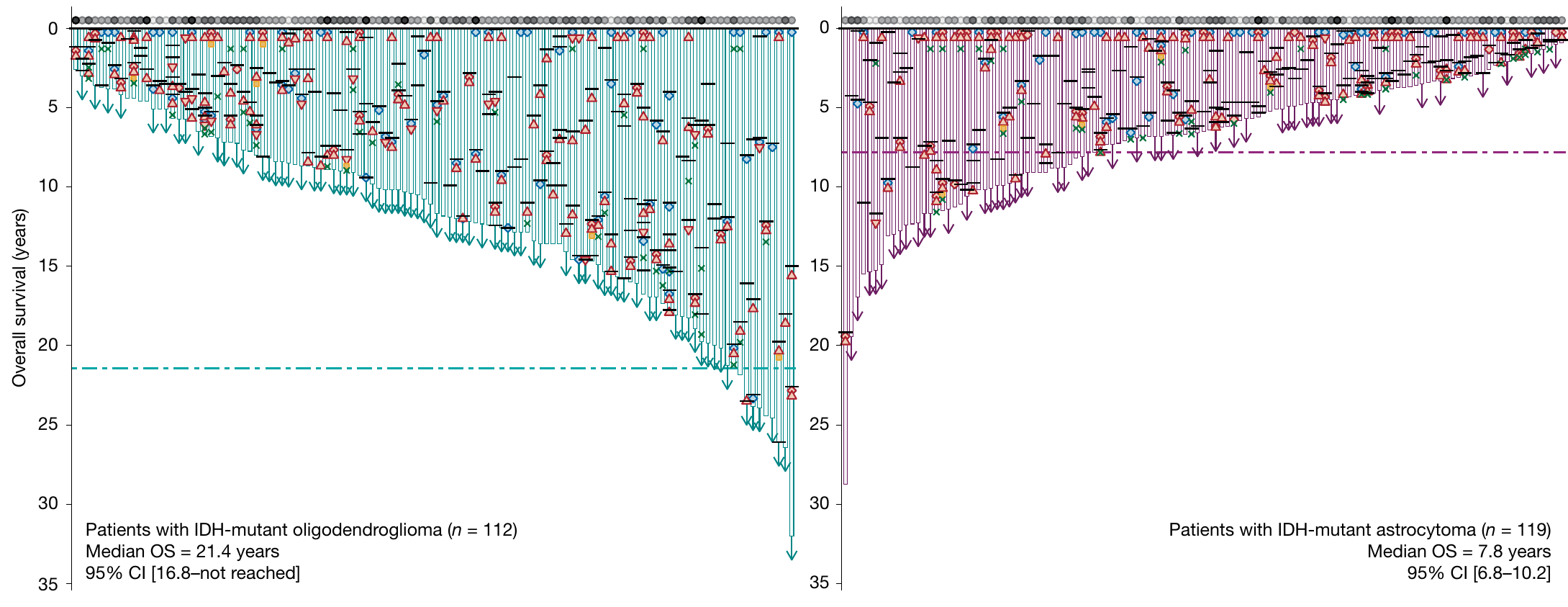
Astrocytomas and oligodendrogliomas are isocitrate dehydrogenase (IDH)-mutant gliomas that most commonly arise in adults under the age of 50 and exhibit variable responses to treatment. To understand the genetic drivers of disease progression, here we used whole-genome and whole-exome sequencing to characterize longitudinally collected tumour specimens from 183 patients with IDH-mutant glioma. Samples were collected through the Glioma Longitudinal Analysis (GLASS) Consortium. Most primary surgery samples were classified as grade 2 on the basis of histology (73% for astrocytomas and 93% for oligodendrogliomas). We validated known genomic markers of tumour progression, including hypermutation and homozygous deletion of CDKN2A or CDKN2B (hereafter, CDKN2A/B), and discovered genetic alterations that distinguish between the evolutionary trajectories of astrocytomas and those of oligodendrogliomas. Mutations in phosphatidylinositol 3-kinase (PI3K) and NOTCH1 were newly acquired in recurrent oligodendrogliomas, regardless of treatment, and were associated with an increased tumour mutational burden. In recurrent astrocytomas, however, again irrespective of treatment, acquired focal oncogene amplifications and CDKN2A/B homozygous deletions were associated with an increase in chromosomal imbalances, which converged with markers of chromosomal instability such as chromothripsis and whole-genome doubling. In both types of IDH-mutant glioma, we observed a convergence of acquired alterations, genome-wide changes and worse patient outcomes, suggesting that treatment-refractory clones were being selected. Treatment with temozolomide was associated with the mutational signatures SBS11 and SBS119 in both tumour types, whereas the radiotherapy-associated ID8 signature increased in astrocytomas specifically. We show that the genomes of oligodendrogliomas and astrocytomas adapt to the selective pressures of tumour progression and treatment in distinct ways, suggesting that oligodendrogliomas and astrocytomas differ in their responses to treatment-induced DNA damage.
Divergent genomic evolution in astrocytomas and oligodendrogliomas
Tamrin Chowdhury, C Mircea S Tesileanu, Emre Kocakavuk, Kevin C Johnson, Joo Ho Lee, Zeynep Erson-Omay, Chaewon Heo, Kenneth Aldape, Samirkumar B Amin, Kevin J Anderson, David M Ashley, Floris P Barthel, Jill S Barnholtz-Sloan, Daniel J Brat, Andrew R Brodbelt, Ana Valeria Castro, Elizabeth B Claus, Jennifer M Connelly, Joseph F Costello, Indrani Datta, Carol Elliott, Gaetano Finocchiaro, Pim J French, Hui K Gan, Luciano Garofano, Padmaja L Ghospurkar, Anna Golebiewska, Pranav S Gundla, Beth Hermes, Chibo Hong, Youri Hoogstrate, Craig Horbinski, Jason T Huse, Antonio Iavarone, Cihat Karadag, Mustafa Khasraw, Mathilde CM Kouwenhoven, Peter S LaViolette, Kay Li, Allison Lowman, Katy McCortney, Hyo-Eun Moon, Nader Sanai, MacLean P Nasrallah, HK Ng, D Ryan Ormond, Bethany Kwan, Marta Padovan, Sun Ha Paek, Laila M Poisson, Sushant Puri, Erica Shen, Shwetal Mehta, Andrew E Sloan, Wies R Vallentgoed, Erwin G Van Meir, Rachael Vaubel, Taylor E Wade, Annemiek ME Walenkamp, Colin Watts, Tobias Weiss, Michael Weller, Pieter Wesseling, Kerryn Westcott, Bart A Westerman, Gordon Y Ye, WK Alfred Yung, GLASS Consortium, Frederick S Varn, Roel GW Verhaak
2026.
Nature. 2026