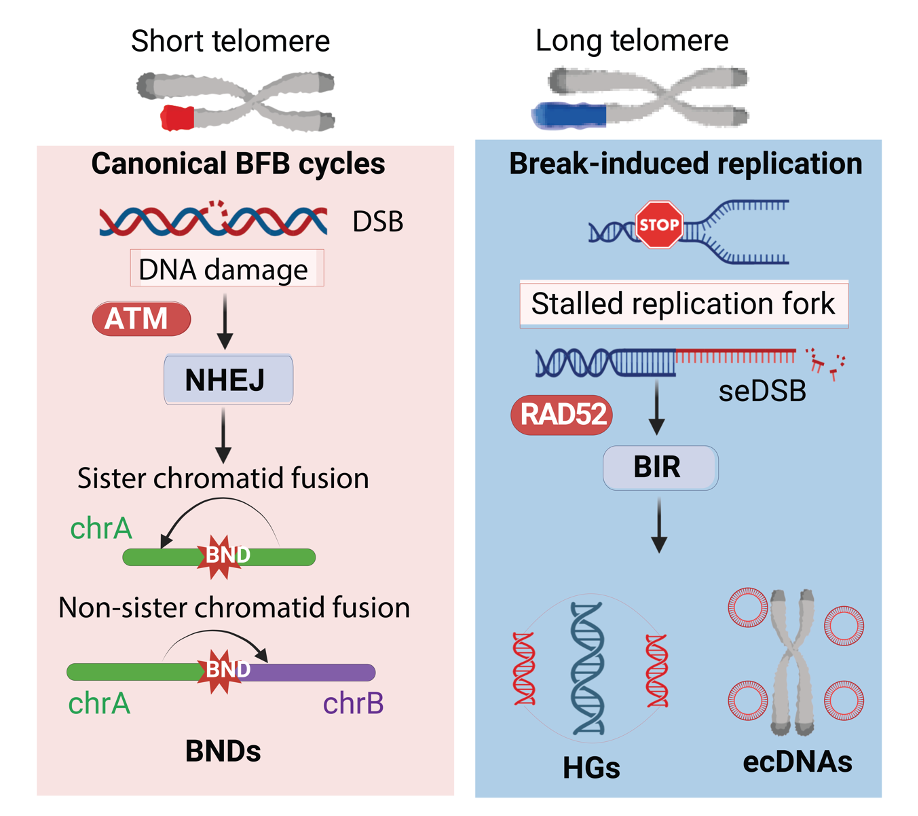
IDH-mutant astrocytomas maintain telomeres through the alternative lengthening of telomeres (ALT) pathway, producing extreme inter-arm telomere length heterogeneity, yet how this heterogeneity shapes structural genome evolution remains unknown. Using Oxford Nanopore long-read sequencing of 20 IDH-mutant astrocytomas, we profiled structural variants (SVs), copy number variants, extrachromosomal DNA (ecDNA) and measured allele-specific telomere lengths from individual long reads. We identified pervasive complex rearrangements, including chromothripsis and foldback events consistent with breakage-fusion-bridge cycles, and widespread ecDNAs. SV breakpoints were enriched at telomeric and centromeric regions regardless of local telomere length, revealing constitutive structural fragility. Arm-level telomere length analysis uncovered a dual-mode model: arms with short telomeres preferentially harbored breakage-associated events, while arms with long ALT-maintained telomeres were enriched for ecDNA and amplification-associated events. These findings identify chromosome-arm-specific telomere length as a determinant of structural genome evolution in ALT-driven tumors.
Chromosome-arm-specific telomere length governs dual modes of structural genome evolution in IDH-mutant astrocytoma
Maryam Jehangir, Kristen L. Drucker, Ayse Keskus, T. Rhyker Ranallo-Benavidez, Orlena Benamozig, Thomas Kollmeyer, Terry C. Burns, Caterina Giannini, Benjamin R. Kipp, Stephen J. Murphy, Amber R. Bridgeman, Jesse R. Walsh, Ramanath Majumdar, Daniel Lachance, Jeanette Eckel-Passow, Ofer Shoshani, Mikhail Kolmogorov, Robert B. Jenkins, Floris P. Barthel†
2026.
bioRxiv. 2026